Gov. Greg Abbott hit Dallas-area officials for allowing local crime and homelessness to recently drive communications giant AT&T out of the area, saying in an exclusive podcast interview with Texas Bullpen that business leaders “complained incessantly” to him about the safety of the third-largest city in the state.
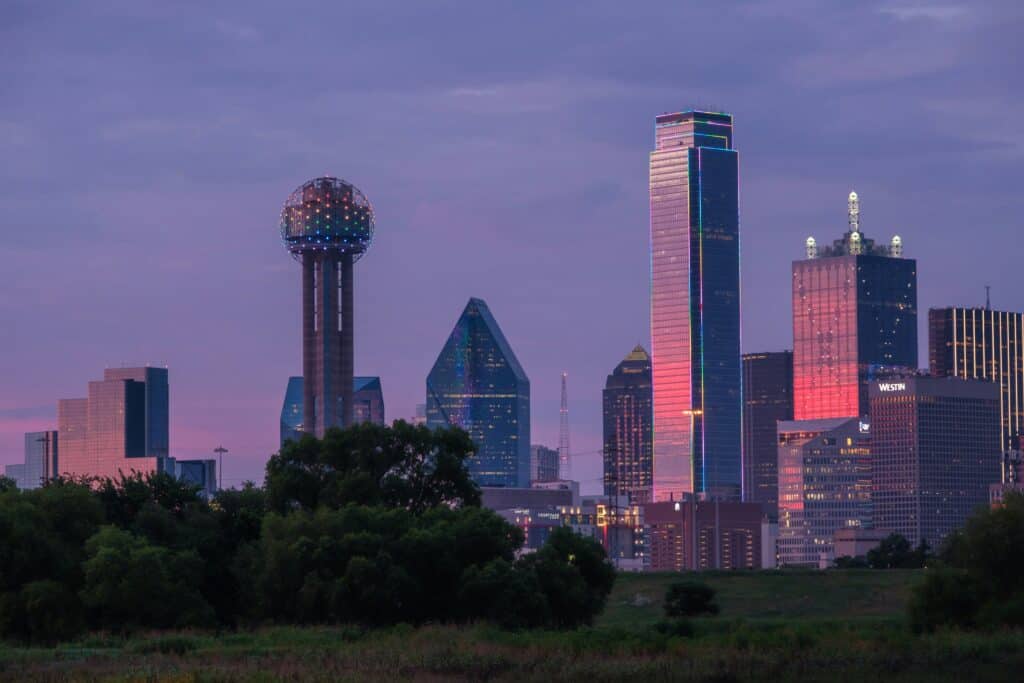
The governor’s comments came days after the multi-billion-dollar telecommunications company announced that it would relocate its downtown Dallas headquarters to Plano, a suburb roughly a half hour away.
AT&T, for its part, did not make any explicit reference to crime or homelessness, with CEO John Stankey writing in a memo to the company announcing the move that this had been a decision a year in the making.
“This location will provide us with the necessary room to cost effectively consolidate all Dallas-Fort Worth Metroplex administrative space, including our three largest locations in Central Dallas, Plano and Irving, and create a corporate campus designed for collaboration, innovation and engagement,” he explained.
Stankey also said that the move would likely trigger “speculation and editorial narrative by those outside the company,” but asked employees to “ignore speculation from uniformed ‘sources’ who are not participating in this work.”
Still, news of AT&T’s departure marks a massive loss for Dallas, with a study estimating that the move would drop downtown property values by 30%, causing a $62 million loss in property taxes for the city.
“Over the last few years, growth in crime and disorder downtown has coincided with loss in value of Downtown properties and slowed residential growth,” the study, commissioned by the Dallas business advocacy group Downtown Dallas Inc., said. “If this trend continues, cascading effects will further and rapidly erode value, impacting the City of Dallas far beyond its Downtown core.”
Abbott, highlighting recent reports that claimed downtown Dallas had the second-highest commercial property vacancy rate in the nation, blamed Dallas leaders “who did nothing” to address the city’s homeless problem or rein in crime. He added that while the city had recently taken steps to increase police presence downtown, changes had come too late.
In November 2024, Dallas voters passed Proposition U, which requires Dallas to dedicate 50% of new revenue to maintaining a police force of at least 4,000 officers, increasing pensions for police and firefighters. In 2025, Dallas exceeded officer hiring goals and recruited “its second-largest class in the department’s history,” per Police Chief Daniel Comeaux.
The City of Dallas’s budget for FY 2025-2026 allocated $1.3 billion for public safety, a 5.6% increase from the previous biennial budget. As of Jan. 7, the Dallas Police Department (DPD) had 3,286 sworn officers, up from the 3,067 it had at the end of 2019. By September 2026, Dallas plans to have at least 3,424 law enforcement officers, making it one of the largest police departments in America.
“It’s these leftist progressive policies,” Abbott said, pivoting to county-level government. “Everybody knows about the leftist Soros-supported District Attorney in Dallas County who lets them loose and lets these dangerous criminals roam the streets.”
John Creuzot, the Dallas County district attorney, has received significant financial backing from organizations funded by major left-wing donor George Soros. Since assuming office in 2019, Creuzot has adopted various non-prosecution policies and frequently collaborates with Soros-backed anti-prosecution groups, such as Fair and Just Prosecution.
“They need to change their approach, or they’re going to decimate downtown Dallas,” Abbott warned.
For their part, Dallas officials have pushed back on claims that crime led to AT&T’s exit, emphasizing the recent crackdown on crime in the Central Business District.
Dallas Mayor Eric Johnson, who became a Republican in 2023 largely due to Democrats’ record on crime, also said that AT&T’s exit was due to the company’s desire for “a large horizontal, suburban-style campus rather than the skyscrapers that define our city center.”
“Dallas is a city of opportunity for workers, families, and businesses of all sizes. In recent years, we have worked together to cut violent crime, homelessness, property tax rates, and bureaucratic red tape,” Johnson continued. “The future of our city – and of our urban core – is bright, and this departure ultimately will open the door for us to explore new possibilities.”
Similarly, Dallas Police Chief Comeaux has pushed back against Abbott’s framing, telling The Dallas Morning News, “It’s not a true depiction of what’s going on in Dallas.”
“Crime is down, recruiting is at an all-time high, and our retention is better this year for officers. The morale is up,” he said. In a statement issued after Abbott criticized Dallas during a Fort Worth event on January 7, the Dallas Police Department (DPD) outlined the increased public safety measures targeting crime in and around the city’s Central Business District.
According to DPD statistics released at the end of 2025, both violent and non-violent crime had decreased city-wide by more than 10% from the previous year. Narrowing in on the Central Business District, crime decreased by 11% with burglaries falling 28%, aggravated assaults dropping 20%, and robberies down 7%. Additionally, downtown Dallas saw decreases in other offenses, such as open container violations, public intoxication and disorderly conduct.
Watch the full Texas Bullpen podcast with Gov. Abbott here.